Building an AI Frontend with Chainlit and OAuth2 Authentication

Today we’ll explore how to build a secure AI frontend using Chainlit. Chainlit is Python framework that allows us to create interactive AI applications. In this example we are going to reuse the weather tool created in a previous post. Also, we will implement OAuth2 authentication with a Nginx as a reverse proxy.

The project consists of four main components:

  1. Nginx Reverse Proxy: Handles authentication via auth_request and routes traffic
  2. Fake OAuth Server: Simple Flask app that simulates OAuth2 authentication
  3. Chainlit Application: The main chat interface with AI capabilities
  4. Strands AI Agent: Weather-focused AI assistant with custom tools

The Nginx configuration implements OAuth2 authentication using the auth_request module:

server {
    listen 8000;

    location / {
        auth_request /oauth2/auth;
        
        auth_request_set $user_jwt $upstream_http_x_user_jwt;
        add_header X-Debug-User-JWT $user_jwt always;
        
        error_page 401 = @error401;
        try_files $uri @proxy_to_app;
    }

    location = /oauth2/auth {
        internal;
        proxy_pass http://oauth2/oauth2/auth;
        proxy_pass_request_body off;
        proxy_set_header Content-Length "";
        proxy_set_header X-Original-URI $request_uri;
        proxy_set_header X-Original-Remote-Addr $remote_addr;
        proxy_set_header X-Original-Host $host;
    }

    location @proxy_to_app {
        proxy_set_header X-User-JWT $user_jwt;
        proxy_pass http://chainlit;
    }
}

Key Features:

  • Every request to / triggers an authentication check via /oauth2/auth
  • JWT token is extracted from the OAuth response and forwarded to Chainlit
  • Unauthenticated users are redirected to the OAuth sign-in page
  • The JWT token is passed to Chainlit via the X-User-JWT header

A simple Flask application simulates an OAuth2 provider for demonstration purposes. In a production environment, you would replace this with a real OAuth2 provider or implemente the whole OAuth2 flow.

@app.get(f"/oauth2/auth")
def auth():
    now = datetime.now()
    response = make_response(jsonify(dict(error='OK')), 200)
    expiration = now + JWT_EXPIRATION_TIMEDELTA
    user = 'gonzalo'
    display_name = 'Gonzalo'
    response.headers['X-User-JWT'] = str(jwt.encode(dict(
        user=user,
        display_name=display_name,
        exp=int(expiration.timestamp())
    ), SECRET, algorithm=JWT_ALGORITHM))
    logger.info("Fake OAuth authentication successful")
    return response

Chainlit processes the JWT token via a custom header authentication callback:

@cl.header_auth_callback
def header_auth_callback(headers: Dict) -> Optional[cl.User]:
    if headers.get("x-user-jwt"):
        jwt_token = headers.get("x-user-jwt")
        try:
            decoded_payload = jwt.decode(jwt_token, SECRET, algorithms=[JWT_ALGORITHM])
            return cl.User(
                identifier=decoded_payload['user'],
                display_name=decoded_payload['display_name'],
                metadata={"role": 'user', "provider": "header"})
        except jwt.ExpiredSignatureError:
            cl.logger.error("Token has expired.")
            return None
    else:
        return None

This callback:

  • Extracts the JWT from the x-user-jwt header
  • Validates the token signature and expiration
  • Creates a Chainlit User object with the decoded information
  • Handles token expiration gracefully

The application uses Strands agents with both base tools and custom weather tools:

agent = get_agent(
    system_prompt=PROMPT_GENERAL,
    base_tools=get_all_base_tools(),
    custom_tools=get_all_custom_tools()
)

Base Tools Include:

  • Calculator
  • Browser access
  • Current time
  • Batch processing
  • Think (reasoning tool)

The weather functionality is implemented using custom Strands tools that fetch meteorological data:

class WeatherTools:
    def __init__(self, latitude: float, longitude: float):
        self.latitude = latitude
        self.longitude = longitude

    def get_tools(self, tools=None) -> List[tool]:
        @tool
        def get_hourly_weather_data(from_date: date, to_date: date) -> MeteoData:
            """
            Get hourly weather data for a specific date range in my city.
            
            Returns:
                MeteoData: Object containing weather readings for temperature, 
                          humidity, precipitation, etc.
            """
            # Implementation details...

The weather tools provide:

  • Hourly weather data for specific date ranges
  • Temperature readings (actual and apparent)
  • Humidity and precipitation data
  • Surface pressure measurements
  • Evapotranspiration data

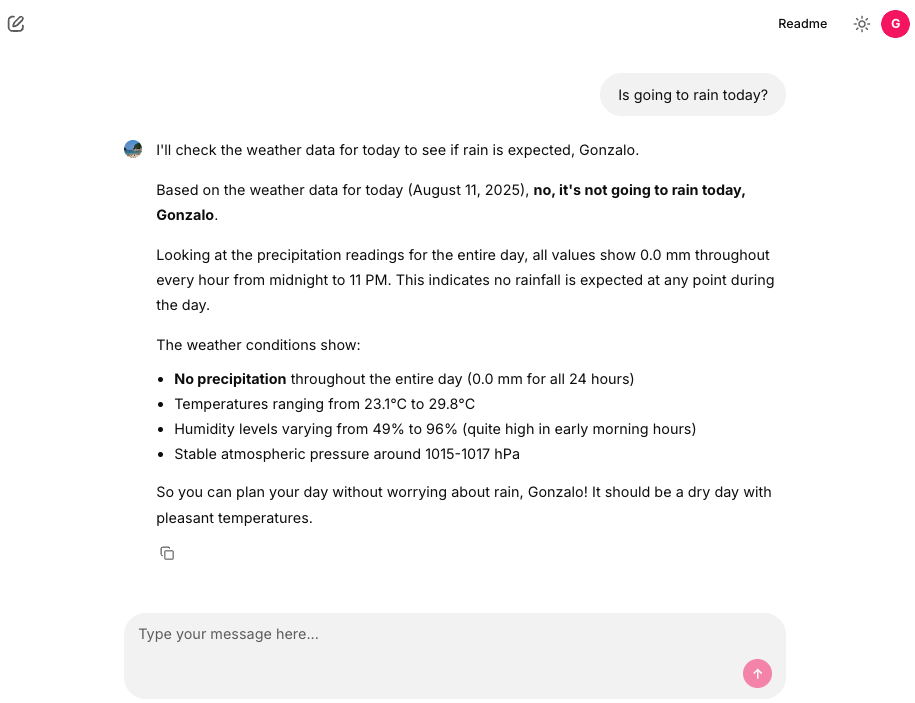
The Chainlit interface provides several starter prompts to help users interact with the weather agent:

@cl.set_starters
async def set_starters():
    return [
        cl.Starter(label="Is going to rain today?", message="Is going to rain today?"),
        cl.Starter(label="tomorrow's weather", message="What will the weather be like tomorrow?"),
        cl.Starter(label="Next 7 days weather", message="Make a weather forecast for the next 7 days."),
    ]

Chainlit also supports message history management, allowing users to see their previous interactions:

@cl.on_message
async def handle_message(message: cl.Message):
    message_history = cl.user_session.get("message_history")
    message_history.append({"role": "user", "content": message.content})
    
    msg = cl.Message(content="")
    await msg.send()
    
    app_user = cl.user_session.get("user")
    question = f"user: {app_user.display_name} Content: {message.content}"
    
    async for event in agent.stream_async(question):
        if "data" in event:
            await msg.stream_token(str(event["data"]))
        elif "message" in event:
            await msg.stream_token("\n")
            message_history.append(event["message"])
    
    await msg.update()

And that’s all. Thanks to Chainlit, we can build AI frontends and integrate them with OAuth2 authentication in a secure and efficient way. The combination of Chainlit’s interactive capabilities and Nginx’s robust authentication features provides a solid foundation for building AI applications that require user authentication.
Full code in my github account

Implementing OAuth2 with a Vue Frontend and Python Backend using Nginx as a Reverse Proxy

We’ve seen in other posts that we can use OAuth2-proxy to provide OAuth2 authentication in our application. Today, for example, we will protect a Vue application, but instead of using oauth2-proxy, we will implement the functionality provided by oauth2-proxy directly in Python.

Our Vue application is very simple: it has only one button that shows some information. The entire Vue application, as well as the backend that serves this information (developed with Flask), will be protected and authenticated with OAuth2. For this example, we will use GitHub as the authentication provider.

<script setup lang="ts">
import {ref} from "vue";

defineProps<{
  msg: string
}>()

const data = ref(null);
const showModal = ref(false);

const fetchData = async () => {
  try {
    const response = await fetch("/app/api/userinfo", { redirect: "manual" });

    const logoutStatuses = [401, 403, 302, 303];
    if (response.type === "opaqueredirect" || logoutStatuses.includes(response.status)) {
      window.location.href = "/app/oauth/logout";
    } else {
      data.value = await response.json();
      showModal.value = true;
    }
  } catch (error) {
    console.error("Error al obtener los datos", error);
  }
};

</script>

<template>
  <div class="greetings">
    <h1 class="green">{{ msg }}</h1>
    <h3>
      You’ve successfully created a project with
      <button @click="fetchData" class="bg-blue-500 text-white p-2 rounded">
        Load data
      </button>
    </h3>
    <div v-if="showModal" class="fixed inset-0 flex items-center justify-center bg-gray-800 bg-opacity-50">
      <div class="bg-white p-6 rounded shadow-lg w-1/3">
        <h2 class="text-xl font-bold mb-4">Datos del Backend</h2>
        <pre class="bg-gray-100 p-3 rounded text-sm">{{ data }}</pre>
        <button @click="showModal = false" class="mt-4 bg-red-500 text-white p-2 rounded">Cerrar</button>
      </div>
    </div>
  </div>
</template>

<style scoped>
h1 {
  font-weight: 500;
  font-size: 2.6rem;
  position: relative;
  top: -10px;
}

h3 {
  font-size: 1.2rem;
}

.greetings h1,
.greetings h3 {
  text-align: center;
}

@media (min-width: 1024px) {
  .greetings h1,
  .greetings h3 {
    text-align: left;
  }
}
</style>

The Flask backend is as follows and allows us to respond with user data in a protected route and a public route.

import logging
from datetime import datetime

from flask import Flask, session
from flask_compress import Compress

from core.oauth_proxy import setup_oauth
from settings import APP_PATH, SECRET, SESSION, DEBUG, OAUTH

app = Flask(__name__)
app.debug = DEBUG
app.secret_key = SECRET
app.config.update(SESSION)
Compress(app)
for logger_name in ['werkzeug', ]:
    logging.getLogger(logger_name).setLevel(logging.WARNING)

setup_oauth(app, OAUTH, APP_PATH)


@app.get(f"/{APP_PATH}/api/userinfo")
def protected_route():
    now = datetime.now().isoformat()
    return dict(
        session=session['user'],
        now=now
    )


@app.get(f"/{APP_PATH}/api/no_auth")
def public_route():
    return "public, route!"

In order to use OAuth2, we need to use a reverse proxy like NGINX. The NGINX configuration file is shown below.

upstream app {
    server host.docker.internal:5000;
}

upstream front {
    server host.docker.internal:5173;
}


server {
    listen 8000;
    server_tokens off;
    proxy_set_header Host $host;
    proxy_set_header X-Real-IP $remote_addr;
    proxy_set_header X-Forwarded-For $proxy_add_x_forwarded_for;
    proxy_set_header X-Forwarded-Proto $scheme;
    proxy_set_header X-Forwarded-Host $host:$server_port;

    location / {
        auth_request /app/oauth2/auth;
        error_page 401 = @error401;
        auth_request_set $auth_cookie $upstream_http_set_cookie;
        try_files $uri @proxy_to_front;
    }

    location /app/api/ {
        auth_request /app/oauth2/auth;
        error_page 401 = @error401;
        auth_request_set $auth_cookie $upstream_http_set_cookie;
        try_files $uri @proxy_to_app;
    }

    location /app/api/no_auth {
        try_files $uri @proxy_to_app;
    }

    location /app/oauth2/ {
        proxy_set_header X-Real-IP               $remote_addr;
        proxy_set_header X-Auth-Request-Redirect $request_uri;
        proxy_pass http://app;
    }

    location @proxy_to_app {
        proxy_pass http://app;
    }

    location @proxy_to_front {
        proxy_pass http://front;
    }

    location @error401 {
        auth_request_set $auth_cookie $upstream_http_set_cookie;
        add_header Set-Cookie $auth_cookie;
        return 302 /app/oauth2/sign_in;
    }
}

The authentication flow is managed as follows, using a small blueprint that handles OAuth2 redirections, token exchange, and user session storage.

import logging
import secrets
from urllib.parse import urlencode

import requests
from flask import Blueprint, jsonify
from flask import request, session, redirect

logger = logging.getLogger(__name__)


def _clean_session():
    session.pop('user', default=None)
    session.pop('state', default=None)
    session.pop('referer', default=None)


def get_oauth_proxy_blueprint(oauth_conf, app_path, *, sub_path="oauth2", callback_url='/callback',
                              signin_url='/sign_in', auth_url='/auth', logout_url='/logout'):
    blueprint = Blueprint('oauth_proxy', __name__, url_prefix=f'/{app_path}/{sub_path}')

    @blueprint.get(callback_url)
    def callback():
        referer = session.get('referer')
        state = request.args.get('state')
        session_state = session.get('state')

        if 'state' not in session:
            return redirect(f"{referer}")
        if state == session_state:
            authorization_code = request.args.get('code')
            token_data = {
                'grant_type': oauth_conf.get('GRANT_TYPE', 'authorization_code'),
                'code': authorization_code,
                'redirect_uri': oauth_conf['REDIRECT_URL'],
                'client_id': oauth_conf['CLIENT_ID'],
                'client_secret': oauth_conf['CLIENT_SECRET']
            }
            response = requests.post(oauth_conf['TOKEN_URL'],
                                     data=token_data,
                                     headers={'Accept': 'application/json'})
            response_data = response.json()
            headers = {
                "Authorization": f"Bearer {response_data.get('access_token')}",
                'Accept': 'application/json'
            }
            user_response = requests.get(oauth_conf['USER_URL'],
                                         data=token_data,
                                         headers=headers)
            if user_response.ok:
                user_data = user_response.json()
                session['user'] = dict(
                    username=user_data['login'],
                    name=user_data['name'],
                    email=user_data['email']
                )
                session.pop('state', default=None)
                session.pop('referer', default=None)
            else:
                _clean_session()
            return redirect(referer)

    @blueprint.get(signin_url)
    def sign_in():
        state = secrets.token_urlsafe(32)
        session['state'] = state
        authorize = oauth_conf['AUTHORIZE_URL']
        query_string = urlencode({
            'scope': oauth_conf.get('SCOPE', 'read write'),
            'prompt': oauth_conf.get('PROMPT', 'login'),
            'approval_prompt': oauth_conf.get('APPROVAL_PROMPT', 'auto'),
            'state': state,
            'response_type': oauth_conf.get('RESPONSE_TYPE', 'code'),
            'redirect_uri': oauth_conf['REDIRECT_URL'],
            'client_id': oauth_conf['CLIENT_ID']
        })
        return redirect(f"{authorize}?{query_string}")

    @blueprint.get(auth_url)
    def auth():
        if not session.get("user"):
            referer = request.headers.get('X-Auth-Request-Redirect')
            session['referer'] = referer
            return redirect(f"oauth2/sign_in", 401)
        else:

            return jsonify(dict(error='OK')), 200

    @blueprint.get(logout_url)
    def logout():
        _clean_session()
        return redirect(logout_url)

    return blueprint


def setup_oauth(app, oauth_conf, app_path, *, sub_path="oauth2", callback_url='/callback',
                signin_url='/sign_in', auth_url='/auth', logout_url='/logout'):
    app.register_blueprint(get_oauth_proxy_blueprint(oauth_conf, app_path, sub_path=sub_path, callback_url=callback_url,
                                                     signin_url=signin_url, auth_url=auth_url, logout_url=logout_url))

You can see the full code of the project in my github

OAuth2 Authentication in Streamlit Applications with Nginx and OAuth2-Proxy

Normally, when I want to provide authentication to a service, I use OAuth2. There are libraries to integrate this authentication mechanism into a web application, but sometimes we cannot do this easily because it is a third-party service over which we have no control. In these cases, it is possible that this third-party service has support for OAuth2 and can also log in with OAuth2. But sometimes this is not possible, or it is too complicated. In these cases, a solution is to use a proxy that handles the authentication and communicates with the third-party service. In this example, we will use a Streamlit application as if it were a third-party application.

import streamlit as st

st.set_page_config(
    page_title="Home",
    page_icon="👋",
)
st.write("# Welcome to Streamlit! 👋")
st.markdown(
    """
    Streamlit is an open-source app framework built specifically for
    Machine Learning and Data Science projects.
    **👈 Select a demo from the sidebar** to see some examples
    of what Streamlit can do!
    ### Want to learn more?
    - Check out [streamlit.io](https://streamlit.io)
    - Jump into our [documentation](https://docs.streamlit.io)
    - Ask a question in our [community
        forums](https://discuss.streamlit.io)
    ### See more complex demos
    - Use a neural net to [analyze the Udacity Self-driving Car Image
        Dataset](https://github.com/streamlit/demo-self-driving)
    - Explore a [New York City rideshare dataset](https://github.com/streamlit/demo-uber-nyc-pickups)
"""
)

st.sidebar.success("Select a demo above.")

Our Streamlit application has a page.

from random import randint

import streamlit as st

st.set_page_config(
    page_title="Hello",
    page_icon="👋",
)

st.markdown("# Plotting Demo")
st.sidebar.header("Plotting Demo")
st.write("This demo illustrates a combination of plotting with Streamlit. Enjoy!")

data = [dict(name=f"name{i}", value=randint(1, 1000)) for i in range(1, 101)]

progress_bar = st.sidebar.progress(0)
status_text = st.sidebar.empty()
chart = st.line_chart([item['value'] for item in data])

progress_bar.empty()

st.button("Re-run")

To use OAuth authentication in the Streamlit application, we are using Nginx as a reverse proxy with the auth_request directive to direct requests to an OAuth2-proxy service deployed in our stack. OAuth2-proxy can be configured to authenticate any OAuth2 server compatible with OpenID. In my example, I am using GitHub, but you can use ActiveDirectory, Google, Keycloak, or even your own OAuth2 server. This is my Nginx configuration:

This is my Nginx configuration:

upstream app {
    server streamlit:8501;
}

upstream oauth2 {
    server oauth2-proxy:4180;
}

server {
    listen 8000;

    location / {
        auth_request /oauth2/auth;
        error_page 401 = @error401;
        try_files $uri @proxy_to_app;
    }

    location /_stcore/stream {
        auth_request /oauth2/auth;
        error_page 401 = @error401;
        proxy_pass http://app/_stcore/stream;
        proxy_http_version 1.1;
        proxy_set_header X-Forwarded-For $proxy_add_x_forwarded_for;
        proxy_set_header Host $host;
        proxy_set_header Upgrade $http_upgrade;
        proxy_set_header Connection "upgrade";
        proxy_read_timeout 86400;
    }

    location @error401 {
        return 302 /oauth2/sign_in;
    }

    location /oauth2/ {
        try_files $uri @proxy_to_oauth2;
    }

    location @proxy_to_oauth2 {
        proxy_set_header Host $host;
        proxy_set_header X-Real-IP $remote_addr;
        proxy_set_header X-Forwarded-For $proxy_add_x_forwarded_for;
        proxy_set_header X-Forwarded-Proto $scheme;
        proxy_pass http://oauth2;
    }

    location @proxy_to_app {
        proxy_set_header X-Forwarded-Proto https;
        proxy_set_header X-Url-Scheme $scheme;
        proxy_set_header X-Forwarded-For $proxy_add_x_forwarded_for;
        proxy_set_header Host $http_host;
        proxy_redirect off;
        proxy_pass http://app;
    }
}

The complete stack can be seen in the docker-compose.yml:

version: '3.9'

services:
  streamlit:
    build: .
    environment:
      - ENVIRONMENT=docker
    command: ["streamlit", "run", "st.py", "--server.port=8501", "--server.address=0.0.0.0"]

  nginx:
    build: .docker/nginx
    ports:
      - "8000:8000"

  oauth2-proxy:
    image: quay.io/oauth2-proxy/oauth2-proxy:v7.8.1
    env_file:
      - .env

And that’s all. The advantage of using oauth2-proxy is that we don’t need to do anything within the Streamlit application to have OAuth2 authentication. This greatly simplifies the integration process, as all the authentication logic is handled outside the main application. Additionally, oauth2-proxy is compatible with any OAuth2 server that complies with OpenID, giving us the flexibility to use different authentication providers. By using Nginx as a reverse proxy, we can efficiently redirect and manage authentication requests, ensuring that only authenticated users can access our Streamlit application.

Full code available in my github account.

Using a nginx reverse proxy to serve docker swarm replicas

Sometimes we need to serve backend servers behind a nginx reverse proxy. For example when we want to serve a Djnago or a Flask application. In this example I want to show how easy is doing that with nginx.

We’re going to start with a dummy Flask application.

from flask import Flask
from datetime import datetime

app = Flask(__name__)

@app.get("/")
def home():
    now = datetime.now()
    return f'Hello {now}'

The idea is use a nginx reverse proxy to serve the application. We can configure nginx to do that like this:

upstream loadbalancer {
    server backend:5000;
}

server {
    server_tokens off;
    client_max_body_size 20M;
    location / {
        proxy_pass http://loadbalancer;
    }
}

And finally we can create our docker-compose.yml file. We only need to set up the replicas and the reverse proxy will do the magic.

version: '3.6'

services:
  nginx:
    image: nginx:production
    ports:
      - "8080:80"
  backend:
    image: flask:production
    deploy:
      replicas: 3
    command: gunicorn -w 1 app:app -b 0.0.0.0:5000

As we can see we have 3 replicas behind a nginx reverse proxy. Maybe it’s enough for us, but maybe we need to distinguish between the replicas, for example in the logging.

(venv) ➜  docker stack services loadbalancer
ID             NAME                    MODE         REPLICAS   IMAGE              PORTS
u5snhg9tysr0   loadbalancer_backend    replicated   3/3        flask:production
4w0bf8msdiq6   loadbalancer_nginx      replicated   1/1        nginx:production   *:8080->80/tcp 

I’ve changed a little bit our Flask application.

import logging
from datetime import datetime
import socket
import os
from logging.handlers import TimedRotatingFileHandler

from flask import Flask

handlers = [
    logging.StreamHandler()
]
if os.getenv('ENVIRONMENT') == 'production':
    slot = os.getenv('SLOT')
    log_path = f"./logs/log{os.getenv('SLOT')}.log"

    file_handler = TimedRotatingFileHandler(log_path, backupCount=2)
    file_handler.setLevel(logging.INFO)
    handlers.append(file_handler)

logging.basicConfig(
    format=f'%(asctime)s ({socket.gethostname()}) [%(levelname)s] %(message)s',
    level='INFO',
    handlers=handlers,
    datefmt='%d/%m/%Y %X'),

logger = logging.getLogger(__name__)

app = Flask(__name__)


@app.get("/")
def home():
    now = datetime.now()
    logger.info(f"home {now}")
    return f'Hello {now} from {socket.gethostname()}. Slot: {os.getenv("SLOT")}'

And of course our docker-compose.yml file.

version: '3.6'

services:
  nginx:
    image: nginx:production
    ports:
      - "8080:80"
  backend:
    image: flask:production
    hostname: "backend.{{.Task.Slot}}"
    environment:
      SLOT: "{{.Task.Slot}}"
      ENVIRONMENT: production
    volumes:
      - log:/src/logs
    deploy:
      replicas: 3
    command: gunicorn -c gunicorn.conf.py -w 1 app:app -b 0.0.0.0:5000
volumes:
  log:
    name: 'log-{{.Task.Slot}}'

Now we’ve changed the hostname of the backend service using the slot number (instead of the default hostname). We also pass a SLOT environment variable to the backend service to distinguish between the replicas, if wee need to do that. Maybe you’re asking yourself, why the hell we need to do that? The answer ins simple: Working with legacy code is hard and sometimes we need to do very stranger things.

Source code of the example in my github